May 5, 2026
Enabling more intelligent daily banking experiences in digital finance
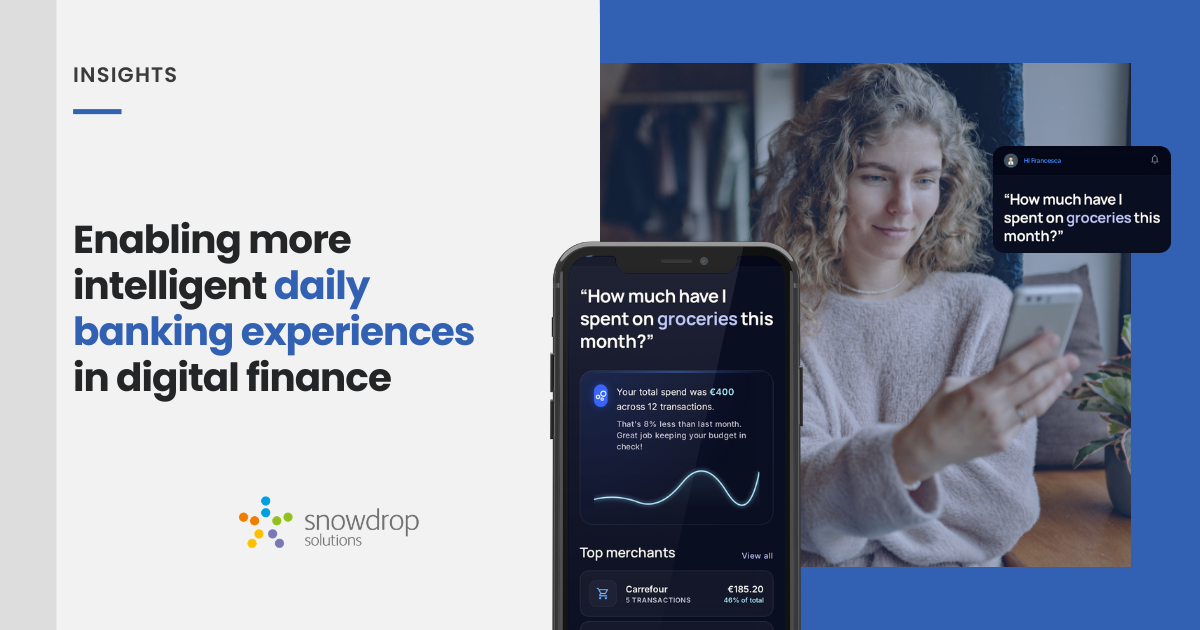
Traditional banks still serve most people, but the way their digital experiences work has not caught up with how people actually manage money today.
Users are expected to interpret transaction lists, recognise merchants, understand where their money is going, anticipate upcoming expenses, and mentally map out what’s coming next. Even with improved interfaces, the experience continues to be purely reactive. If you want answers, the user has to go looking and often do the maths in their head.
So user expectations are rapidly changing. Users increasingly look to their bank for clarity, context, and timely guidance on their day-to-day finances.
This shift is being accelerated by the steady move towards digital payments and using less cash, which means users now have far more complete and accessible records of their day-to-day financial activity. As a result, a new type of interaction within digital banking is emerging. Behaviours such as understanding everyday spending, being alerted to upcoming expenses, or assessing what can realistically be afforded are becoming increasingly common.
We refer to these as daily banking: a set of everyday financial interactions where users expect immediate answers, contextually relevant information, and clear guidance grounded in their current financial situation.
The foundation: structured and enriched transaction data
Before introducing AI into the equation, there is a critical foundation that must be in place: high-quality, structured and accurate transaction data.
Many everyday banking questions do not require artificial intelligence. They require clarity and accuracy.
For example, when a user asks: “How much have I spent on groceries this month?”, the answer depends on accurate categorisation, merchant identification, and clean transaction data. This is where transaction enrichment plays a critical role.
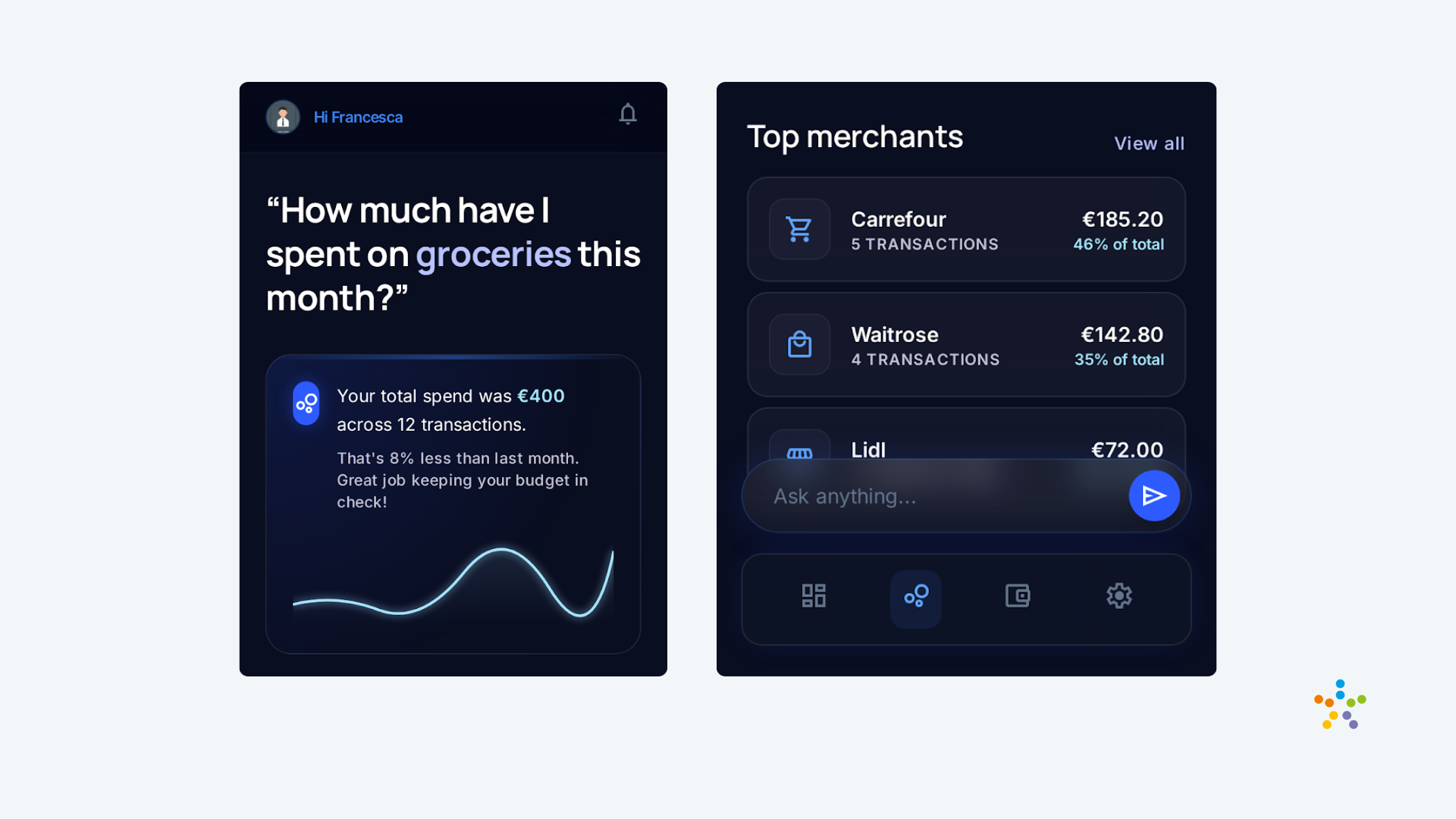
By transforming raw, confusing transaction strings into enriched data, including clear merchant names, logos, locations, and consistent categories, banks can instantly answer these types of queries without additional complexity.
This layer is essential. Without it, even the most advanced AI models would struggle to deliver reliable or meaningful insights.
When AI becomes essential: from answers to forward-looking insights
While transaction enrichment enables visibility and understanding, AI becomes critical when moving beyond historical data into forward-looking, scenario-based questions.
Users are increasingly asking more complex questions that require interpretation, prediction, and context. For example: “How much could I save if I cancel my streaming subscriptions?” “What can I realistically afford to spend on holidays this year?”
These are not simple queries. They require combining multiple data points, recurring expenses, income patterns, existing commitments, and potential behavioural changes.
AI can bridge this gap by analysing historical patterns, identifying relevant variables, and filling in missing context to provide realistic, personalised answers.
From insights to proactive financial guidance
Daily banking capabilities are all about guiding users towards better financial decisions.
By combining enriched transaction data with AI-driven analysis, banks can move from reactive interactions to proactive support.
For instance, when recurring income, such as salary, freelance payments, or rental income, is identified, changes in these patterns can trigger meaningful actions. A salary increase could prompt a suggestion to strengthen an emergency fund, accelerate savings goals, or explore investment options.
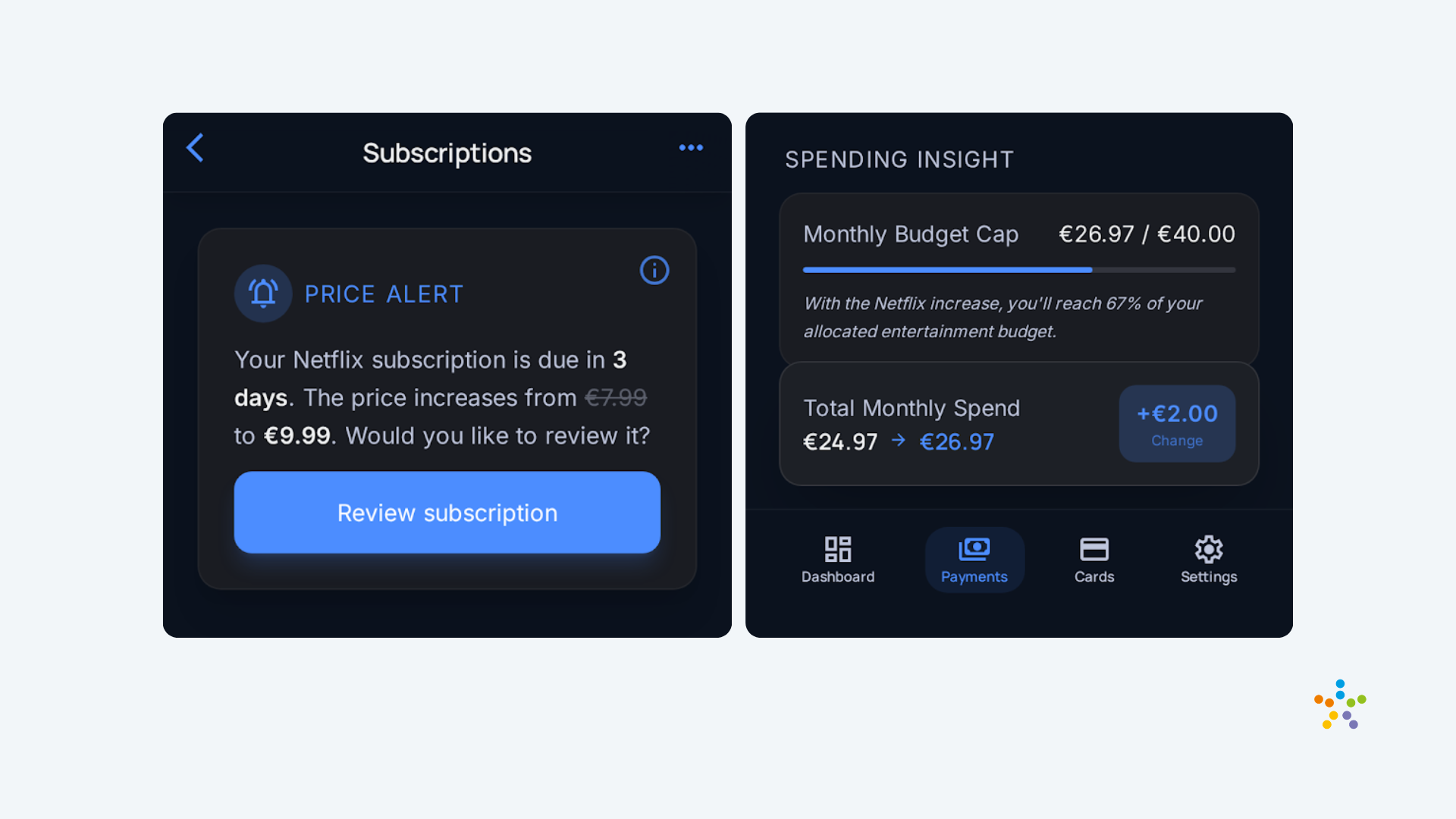
On the expense side, recognising subscriptions, memberships, and regular bills allows banks to detect changes in spending behaviour. An increase in a recurring charge or an unusual pattern can trigger a timely nudge, encouraging users to review, adjust, or even cancel a service.
These interactions help users make better decisions without requiring constant effort or attention.
Making everyday financial management more effortless and contextual
Another key expectation from users is to stay informed, but in a way that is relevant and easy to act upon.
Daily banking experiences should include timely alerts around renewals, missed payments, price changes, and upcoming expenses. These capabilities become significantly more valuable when powered by enriched and well-structured data.
Building on this, banks can provide simple spending forecasts based on historical patterns. By anticipating upcoming outgoings and income, users gain a clearer picture of their short-term financial position.
More importantly, these insights can help identify potential cash-flow issues before they arise, as well as highlight opportunities to save. When combined with well-timed nudges, this supports the development of healthier financial habits and more confident day-to-day decision-making.
Building towards more intuitive banking experiences
Delivering effective daily banking experiences depends on getting two things right: data and intelligence.
Transaction enrichment provides the structure and clarity needed to understand financial behaviour. AI builds on top of this foundation to deliver deeper insights, answer more complex questions, and support smarter decisions.
Together, they enable a more intuitive approach to digital banking. One where users no longer need to interpret raw data or make assumptions on their own.
For traditional banks, this represents an opportunity to modernise existing digital channels. For neobanks and fintechs, it is a way to differentiate through more relevant and responsive user experiences.
What comes next
The direction of travel is clear. Users expect their bank to do more than present information. They expect it to interpret, anticipate, and guide.
By combining enriched transaction data with AI, where it adds real value, banks can deliver everyday experiences that feel simple, helpful, and aligned with how people actually manage their money.
This is not about introducing entirely new behaviours, but about improving the ones that already exist, making daily financial decisions easier, faster, and better supported.

Marketing & Comms Director
Seasoned Marcomms professional with 8+ years of experience in brand management and digital communications. I thrive on creating impactful content and creative strategies, leveraging location-enhanced data enrichment insights for financial and digital technology companies. In my spare time, I nurture my mind and spirit through creative pursuits and immersive reading.