March 31, 2025
What to Look for in a Secure Transaction Data Enrichment Partner
5 minutes
Last updated on: March 27, 2026
Reviewed by: Ana Cantero
When financial institutions process transaction data, accuracy is only part of the equation. Security, data isolation, and regulatory compliance are equally critical. Even small gaps in transaction data governance can quickly lead to larger problems: confused customers, increased support queries, and unnecessary operational costs.
In a sector built on trust, “good enough” is rarely enough. Banks must be confident that the systems processing and enriching transaction data operate with precision, reliability, and strict safeguards around sensitive information.
Choosing the right transaction data enrichment partner, therefore, goes far beyond improving how transactions appear in a banking app. It also means ensuring that customer data is handled with care, protected by strong security controls, and processed in a way that maintains clear separation between users at all times.
How to Choose the Right Transaction Enrichment Partner
Your choice of provider can influence both the customer experience and the operational resilience of your banking services. Financial institutions should look for a solution that:
- Integrates smoothly with existing core banking systems and payment infrastructure
- Delivers accurate and consistently validated transaction insights
- Scales globally across currencies, markets, and languages
- Maintains strict data handling and user-level data separation standards
- Strengthens transparency and trust between banks and their customers
Key Security Considerations in Transaction Data Enrichment
Financial institutions process vast amounts of sensitive transaction data daily. Ensuring that a transaction enrichment provider applies strong technical and organisational safeguards is non-negotiable. Key aspects to consider include:
- Data Encryption in Transaction Enrichment: All data — both in transit and at rest — should be encrypted using industry standards such as AES-256 and TLS 1.2+ to prevent unauthorised access.
- Personally Identifiable Information (PII) Protection: Providers should apply techniques such as anonymisation or tokenisation to protect personally identifiable information while maintaining compliance with global data protection laws.
- Access Controls for Secure Data Handling: Robust identity and access management policies are essential. Multi-factor authentication (MFA), role-based access control (RBAC), and strict privilege management ensure that only authorised personnel can access sensitive data.
- Strong Data Segregation and Processing Controls: Transaction enrichment platforms should be designed to ensure strict separation of customer data at every stage of processing, reducing the risk of cross-account exposure and maintaining the integrity of individual user records.
Regulatory Compliance and Certifications for Transaction Data Security
Security practices must also be supported by recognised standards and regulatory compliance. Financial institutions should ensure their transaction enrichment partner demonstrates adherence to industry regulations and possesses relevant certifications, including:
General Data Protection Regulation (GDPR) Compliance
Ensures customer financial data is processed responsibly, transparently, and with clear governance.
ISO 27001 Certification for Financial Data Security
A globally recognised information security management standard that demonstrates structured risk management, strong internal controls, and continuous monitoring of security practices.
Data Residency and Sovereignty Compliance
Providers should clearly communicate where enriched transaction data is processed and stored, ensuring alignment with regional data protection requirements and cross-border transaction regulations.
Risk Mitigation Strategies When Choosing a Security Transaction Enrichment Partner
Beyond security controls and certifications, banks should also review how enrichment partners manage operational risk. Key elements include:
- Regular Security Audits for Transaction Data Handling: Independent security assessments, penetration testing, and vulnerability scans should be conducted frequently.
- Incident Response Plan for Transaction Data Breaches: A well-documented and tested response strategy should be in place to manage security breaches effectively.
- Service-Level Agreements (SLAs) on Data Security: Clearly defined SLAs should outline security commitments, uptime guarantees, and data breach notification procedures.
- Transparency in Data Handling for Enriched Transactions: The provider should offer clear documentation on how transaction data is processed, stored, and secured, ensuring full visibility into security protocols.
Key Concerns When Evaluating a Transaction Enrichment Provider
Not all enrichment solutions meet the security and governance standards required by financial institutions. Potential warning signs include:
- Limited transparency around security policies or data handling procedures
- Missing or outdated industry certifications
- Poor visibility into how data is processed and segregated
- Weak access control frameworks or limited authentication safeguards
- A history of unresolved security vulnerabilities or service disruptions
Selecting a provider without robust safeguards can expose banks to operational risk, reputational damage, and loss of customer confidence.
Why Financial Institutions Choose Snowdrop for Secure Transaction Data Enrichment
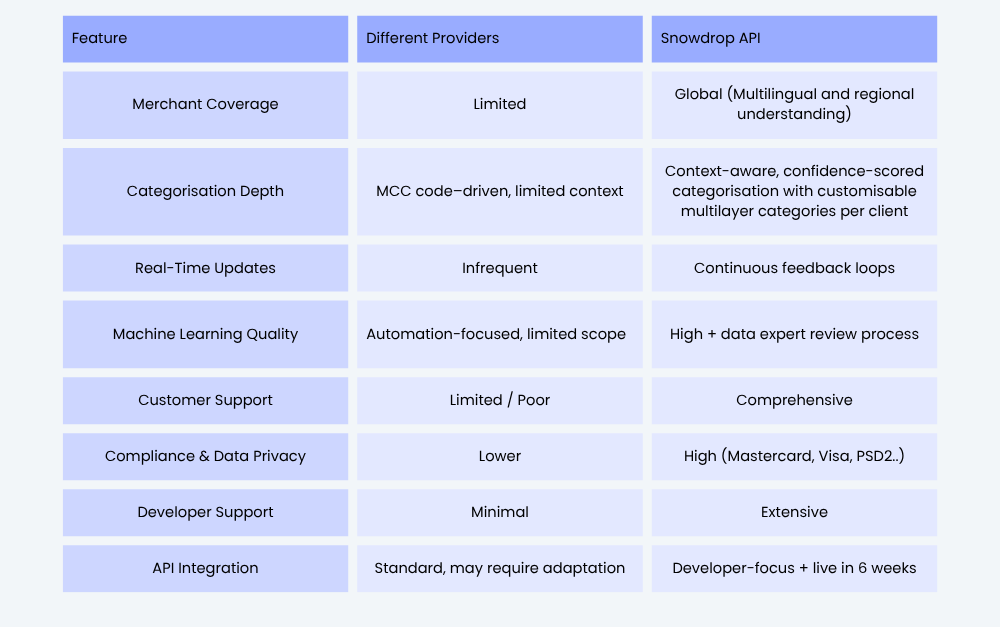
Snowdrop Solutions supports banks and fintechs in delivering clearer transaction insights while maintaining strict security and compliance standards. As a trusted Google partner, Snowdrop’s enrichment platform is built on secure cloud infrastructure and applies advanced encryption, controlled access management, and structured data governance to protect sensitive financial data.
Snowdrop Solutions’ Merchant Reconciliation System (MRS) API, powered by Google Cloud and Google Maps, transforms ambiguous payment descriptors into clear, contextual insights.
The solution has already been deployed by multiple European banks, with implementation timelines as short as six weeks, enabling institutions to modernise transaction clarity without long integration cycles.
Our adherence to GDPR and ISO 27001 standards ensures institutions can meet regulatory requirements while maintaining transparency and operational resilience. Regular security reviews, clearly defined SLAs, and documented data processing practices provide banks with confidence that enriched transaction data is handled responsibly and securely.
By combining accurate transaction enrichment with strong data governance and security controls, financial institutions can improve clarity for customers while maintaining the trust that modern banking depends on.

Marketing & Comms Director
Seasoned Marcomms professional with 8+ years of experience in brand management and digital communications. I thrive on creating impactful content and creative strategies, leveraging location-enhanced data enrichment insights for financial and digital technology companies. In my spare time, I nurture my mind and spirit through creative pursuits and immersive reading.